

Monotheism in the New Religious Movements of Japan: Historical and Taxonomical Challenges in Western Studies
(Routledge – Routledge Studies in Religion series; Forthcoming – pre-order on June 13, 2025; available after July 4, 2025 – order here)

This book calls for a reformation of the image of monotheism in studies of Japanese religions and in the study of religions in general. According to most scholars, ‘Japan’ and ‘monotheism’ mix like oil and water. Whatever Japanese religion is, we are told, the ‘Western’ category of monotheism cannot not be imposed. The predominance of this standard ruling makes critical the study of Japan’s new religious movements (NRMs)—exemplified in this volume by Kurozumikyō, Tenrikyō, and Konkōkyō, which have occasionally and controversially been pinned with the monotheism label. However, significant disagreement and confusion have persisted for nearly a century in Western scholarship over precisely how to classify these religions and furthermore over where their monotheism, if it exists, might have come from. Chandler argues that this long history of dissonance in the West is the result of a complex layering of taxonomical, sociocultural, and scholarly issues. Furthermore, he suggests this impasse can be addressed via an updated definition of monotheism that takes into account its nuances and includes new monotheistic subcategories. The book reveals the monotheism of Japan’s NRMs in light of this new framework and through a new historical investigation into Japanese sources of monotheism. It is especially relevant to scholars with an interest in Japanese religions and new religious movements as well as the comparative study of religion and philosophy of religion.
Release date after July 04, 2025.
Note: This book is based on my doctoral research at the University of Cape Town, supervised by Prof. Elisabetta Porcu.
Constantine and the Divine Mind: The Imperial Quest for Primitive Monotheism
(Wipf & Stock, Published Dec 2019)

Few subjects seem to have posed a bigger challenge to historians of Rome and early Christianity than Constantine’s relationship with the Christian religion. Indeed, the emperor’s dramatic turn to the Christian god remains one of history’s most controversial and hotly-debated episodes: Was Constantine’s conversion “sincere”? If so, why did he convert? When did this conversion take place? And what kind of Christian did he ultimately become?
In Constantine and the Divine Mind, I offer a new historical proposal about the reason for Constantine’s famous conversion to Christianity, and a new portrait of Constantine as a deeply religious man who believed he was on a divine quest to restore the original religion of mankind. By tracing this quest, I illuminate the process by which he embraced the Christian god, and how the reasons for that embrace continued to manifest in his religious policies.
Now available for order on Wipf and Stock’s website here.
Thomas Emlyn’s An Humble Inquiry into the Scripture-Account of Jesus Christ (1702) [Introduction + Editor]
(Theophilus Press, 2021)
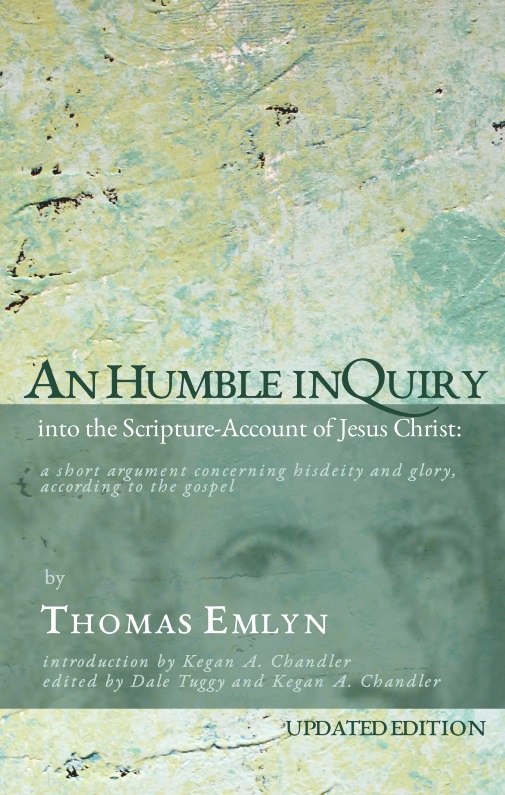 In 1720 the English Presbyterian minister and theologian Thomas Emlyn (1663-1741) wrote An Humble Inquiry, a succinct and erudite argument for the subordination of Jesus Christ to God the Father. Because of his unitarian understanding of biblical Christology and theology he was expelled by his denomination, and in 1703 he was tried for blasphemy by the state. Sentenced to prison and deprived of his wealth, Emlyn’s persecution by both the state and his fellow Protestants became an exemplar of the need for religious tolerance.
This new Updated Edition makes Emlyn’s potent and controversial eighteenth-century book accessible to twenty-first century readers, and is enhanced by notes, scriptural citations, a complete bibliography of Emlyn’s writings, and a historical introduction.
The book’s introduction was written by myself and the text’s detailed historical footnotes were provided by myself and Dr. Dale Tuggy.
Now available for order here.
The God of Jesus in Light of Christian Dogma
(Restoration Fellowship, 2016)
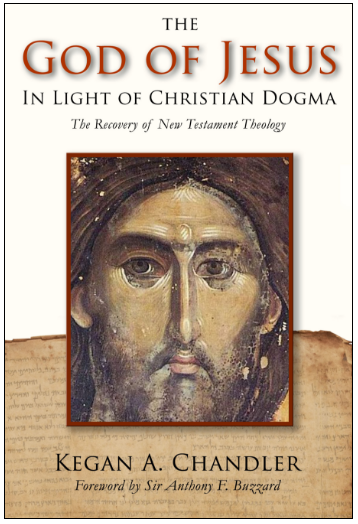
The God of Jesus is a semi-popular level book offering readers an intense, detailed journey through roughly five-hundred years of ecclesiastical disputation on the nature of God and Jesus, providing a pointed challenge to popular interpretations of the Christology of the New Testament.
The first half of the book covers the developmental history of orthodox theology and some of its early challenges, with a focus on the philosophical principles behind the creeds of the “ecumenical” Church councils of the fourth and fifth centuries. The second half of the book provides a fresh look at the vibrant world of first-century Judaism, and Jesus’ and his earliest disciples’ teachings within that world. The overarching question of the book is this: what place, if any, do the philosophical concerns of fourth-and-fifth-century orthodoxy have in the theology of the man Jesus of Nazareth? In light of the history of dogma, as well as modern New Testament scholarship, is the “orthodox” interpretation of the biblical documents our best and only option? Is the Trinity the God of Jesus?
Sir Anthony F. Buzzard has honored me with a foreword. Professor Buzzard is an Oxford scholar, linguist, and an instructor at Atlanta Bible College. Restoration Fellowship published the book in August 2016.
Now available for order on Amazon here.
(Note: Readers interested in my academic work may benefit from knowing that this semi-popular text, which is theological in orientation, was completed prior to my disciplinary interest and education in the academic study of religions. Despite coming to view a few supporting historical details differently, I nevertheless concur with its general historical argument, and the book continues to be popular with readers interested in Christology (having sold a few thousand copies as of this writing). While a Second Edition is warranted, I am unsure if it will ever be completed, having now alternative interests and limited time. The book’s German Edition, which can also be obtained via Restoration Fellowship, does feature a few revisions to a small number of supporting historical details, namely in the book’s introductory chapter.)


 Kegan Chandler, PhD